

When Esri recently published their findings on configuring enterprise geodatabases with SAP HANA Cloud, they confirmed the technical viability of this database-as-a-service option for enterprise GIS operations. At CyberTech, we had the privilege of partnering with both Esri and SAP to conduct comprehensive testing that informed these conclusions. Now, we’d like to share our perspective on what we learned during this validation journey.
Why This Testing Mattered
As organizations continue their digital transformation initiatives, database-as-a-service offerings present an alternative to managing on-premises database servers. Our role was to validate whether SAP HANA Cloud could reliably support real-world gas utility network workflows—ensuring that what works in theory actually delivers when editors are tracing networks, web users are viewing dashboards, and the system is handling concurrent loads that mirror actual operational environments.
The Testing Environment
We built a highly available ArcGIS Enterprise environment on AWS spanning two regions. The ArcGIS infrastructure resided in the US East 2 (Ohio) region, while SAP HANA Cloud was deployed in US East 1 (Virginia), connected via VPC peering and SAP PrivateLink Service. This multi-region architecture allowed us to evaluate how the system performs under realistic network conditions. The environment was designed around an organization with 15 ArcGIS Pro editors and 200 web/mobile viewers, which represents a typical mid-sized utility operation. We provisioned SAP HANA Cloud with 32 vCPUs and 256GB of memory to host the Gas Utility Network database.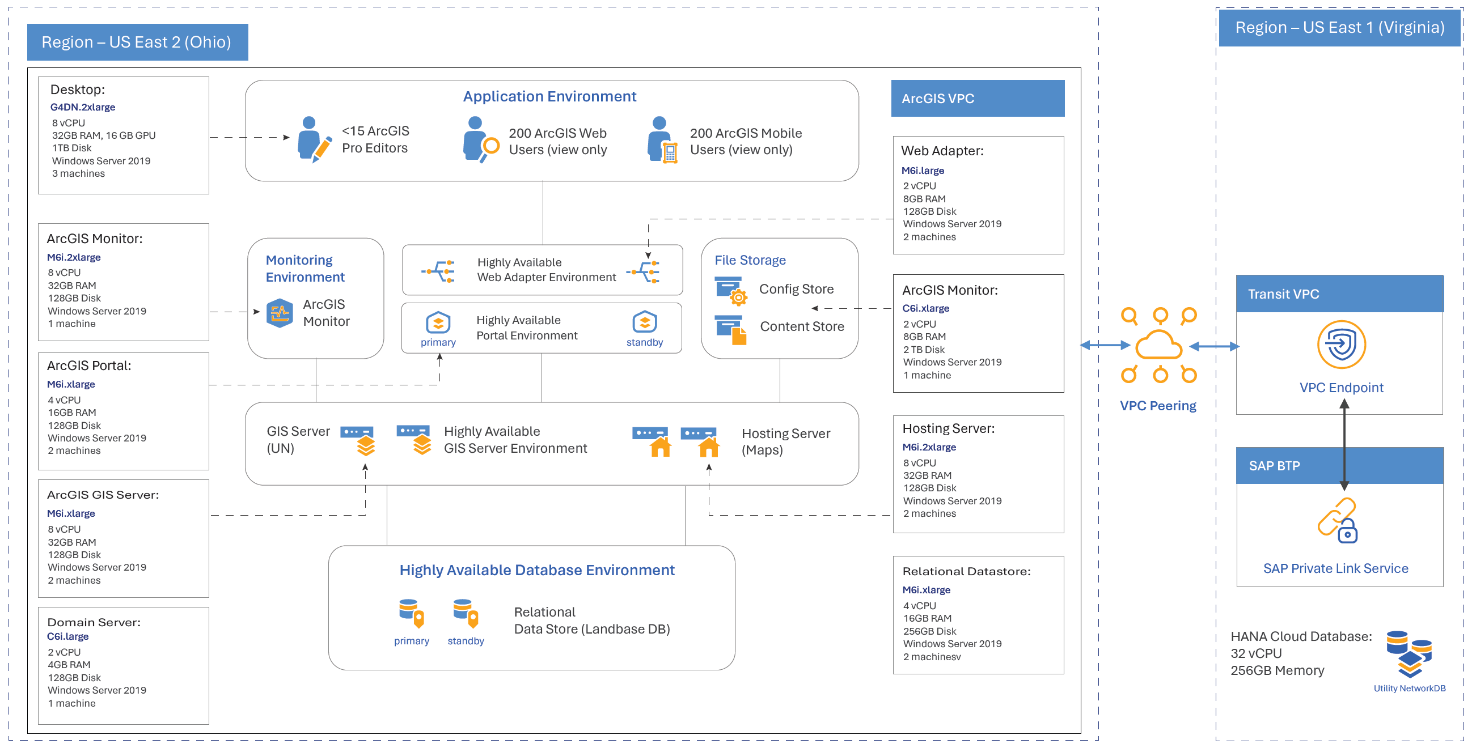
Figure 1: Deployment Architecture
Workflow Validation: The Real Test
We tested nine distinct workflows that cover the full lifecycle of gas network management:Each workflow was executed multiple times under varying load conditions. We tested at baseline load (1x), then progressively increased to 2x, 4x, and 6x loads.
What the Numbers Tell Us
The results demonstrated successful interoperability between ArcGIS Enterprise and SAP HANA Cloud. Here’s what stood out:
Resource Utilization Remained Low
Even under our highest load scenarios—6x baseline load with doubled simultaneous operations—SAP HANA Cloud CPU utilization peaked at just 12%, while memory utilization stayed consistently around 6%. These low utilization levels indicate the database configuration had significant capacity beyond what our test scenarios demanded.

Figure 2: Load Test Results Summary
Error-Free Operation
The most critical finding: throughout all load testing scenarios, we observed zero workflow errors. Every operation completed successfully, from simple asset viewing to complex network tracing and editing workflows. This error-free execution demonstrates the stability of the integration between ArcGIS Enterprise and SAP HANA Cloud across all tested workflows.
Network Tracing Performance
Network tracing is often one of the most demanding operations in a utility network environment. Throughout our testing, trace operations executed successfully at all load levels without encountering errors or failures, validating that the complex spatial and network topology operations required by the Utility Network framework function properly with SAP HANA Cloud.

Figure 3:Total Execution Times for Workflows
The Cross-Region Consideration
One critical finding aligns perfectly with Esri’s recommendation: network latency matters. Our test architecture intentionally placed ArcGIS Enterprise and SAP HANA Cloud in different AWS regions to understand this impact. While the system performed well, we observed that operations requiring frequent data exchange between the application and database layers were sensitive to the cross-region latency.
For production deployments, we strongly recommend deploying SAP HANA Cloud in the same region as your ArcGIS Enterprise components. The performance gains from reduced latency will be noticeable, particularly for editor workflows that involve frequent database interactions.
Beyond the Metrics
Numbers tell part of the story, but the real validation came from watching the workflows execute smoothly, seeing the utility network topology maintained correctly, and observing how the system handled the complex spatial relationships that make utility network management possible.
The Utility Network framework in ArcGIS relies on sophisticated database functionality—spatial indexes, connectivity rules, network topology, and attribute rules all working in concert. SAP HANA Cloud supported these requirements without issue, which demonstrates a mature level of interoperability between the two platforms.
What This Means for Utility Organizations
If you're a utility exploring database-as-a-service options for your GIS infrastructure, these test results provide confirmation that SAP HANA Cloud can support ArcGIS Enterprise deployments. The testing demonstrated:
- Functional reliability through error-free workflow execution across all tested scenarios
- Technical compatibility supporting both editing and viewing workloads concurrently
- Network topology support for the complex spatial operations that utility networks require
Looking Forward
This testing represented an initial validation of SAP HANA Cloud as an enterprise geodatabase option. As with any technology decision, we recommend organizations conduct their own proof-of-concept testing with their specific data volumes and workflow patterns. What we can confirm is that the foundational integration works as expected.
We’re grateful to have partnered with Esri and SAP on this validation effort. The collaboration helped establish baseline performance characteristics and confirm functional compatibility before organizations invest in migration or new deployments.
For utilities evaluating their GIS infrastructure options, this validation work adds another data point to the decision-making process.